
Thursday, October 25, 2012
Detecting Causality in Complex Ecosystems
"Identifying causal networks is important for effective policy and management recommendations on climate, epidemiology, financial regulation, and much else. We introduce a method, based on nonlinear state space reconstruction, that can distinguish causality from correlation. It extends to nonseparable weakly connected dynamic systems (cases not covered by the current Granger causality paradigm)." Full article @ Science

Labels: causality, complex systems, correlation, dynamical systems, statistics


Thursday, October 11, 2012
A Dynamical-Systems View of Stem Cell Biology
"During development, cells undergo a unidirectional course of differentiation that progressively decreases the number of cell types they can potentially become. Stem cells, however, keep their potential to both proliferate and differentiate. A very important issue then is to understand the characteristics that distinguish stem cells from other cell types and allow them to conduct stable proliferation and differentiation. Here, we review relevant dynamical-systems approaches to describe the state transition between stem and differentiated cells, with an emphasis on fluctuating and oscillatory gene expression levels, as these represent the specific properties of stem cells. Relevance between recent experimental results and dynamical-systems descriptions of stem cell differentiation is also discussed." Full perspective @ Science

Labels: attractor behavior, complexity, development, dynamical systems, epigenetic landscape, modeling
Thursday, September 27, 2012
32 metronomes attaining spontaneous synchrony
I'm different, I'm different, I'm different... No i'm not, no I'm not, no I'm not.... 32 metronomes attaining spontaneous synchrony - Boing Boing
Thank you Mike Conover!
Thank you Mike Conover!
Labels: attractor behavior, dynamical systems, synchronous
Thursday, September 23, 2010
Reaction-Diffusion Model
"The Turing, or reaction-diffusion (RD), model is one of the best-known theoretical models used to explain self-regulated pattern formation in the developing animal embryo. Although its real-world relevance was long debated, a number of compelling examples have gradually alleviated much of the skepticism surrounding the model. The RD model can generate a wide variety of spatial patterns, and mathematical studies have revealed the kinds of interactions required for each, giving this model the potential for application as an experimental working hypothesis in a wide variety of morphological phenomena. In this review, we describe the essence of this theory for experimental biologists unfamiliar with the model, using examples from experimental studies in which the RD model is effectively incorporated.". Full review @ Science

Labels: complex systems, development, dynamical systems, reaction-diffusion, turing
Wednesday, September 22, 2010
Complex systems: Foreseeing tipping points
"Theory suggests that the risk of critical transitions in complex systems can be revealed by generic indicators. A lab study of extinction in plankton populations provides experimental support for that principle." Full news article @ Nature. Se also the research article:
John M. Drake & Blaine D. Griffen [2010]. "Early warning signals of extinction in deteriorating environments". Nature 467 , 456–459

John M. Drake & Blaine D. Griffen [2010]. "Early warning signals of extinction in deteriorating environments". Nature 467 , 456–459
Labels: biocomplexity, complex systems, dynamical systems
Monday, September 20, 2010
Bizarre Robot Traders
"On the quantitative trading forum, Nuclear Phynance, the consensus on the patterns seemed to be that they simply just emerged. They were the result of "a dynamical system that can enter oscillatory/unstable modes of behaviour," as one member put it. If so, what you see here really is just the afterscent of robot traders gliding through the green-on-black darkness of the financial system on their way from one real trade to another." Full article @ The Atlantic
Thanks Mike for the link!

Thanks Mike for the link!
Labels: artificial intelligence, dynamical systems, robots
Friday, September 03, 2010
Workshop on Guided Self-Organization
The School of Informatics & Computing (SoIC), Complex Networks and Systems Center for Research (CNetS), and Pervasive Technology Institute (PTI) at Indiana University (IU) are pleased to host the 3rd International Workshop on Guided Self-Organization, September 4-6, 2010. Please join us!
The GSO 3 Program

The GSO 3 Program
Labels: dynamical systems, information, self-organization
Wednesday, January 20, 2010
Engineering cellular synchrony
"Scientists have engineered bacteria that can communicate with each other in a synchronized manner, lighting up in waves of fluorescent green [...] The engineered cells also offer a new model system for studying emergent systems, or how complex properties -- such as synchronized oscillation -- arise from simpler starting materials -- a two genes network." Full article @ The Scientist.

A supernova burst in a colony of coupled genetic clocks after critical cell density.
Image: Tal Danino, Octavio Mondragon-Palamino, Lev Tsimring
Labels: bacteria, complexity, dynamical systems
Tuesday, March 03, 2009
Mathematica Demos
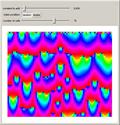
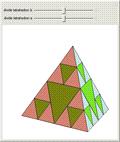
Wolfram has prepared a very nice showcase with visualizations and implementations of several models (many with discrete dynamical systems, of course) in Mathematica.
Labels: computation, dynamical systems, tools

