"Scientists in the US have built and tested robotic ants that they say behave just like a real ant colony. The robots do not resemble their insect counterparts; they are tiny cubes equipped with two watch motors to power the wheels that enable them to move. But their collective behaviour is remarkably ant-like." News @ BBC News
"For the first time, synthetic biologists have created a genetic device that mimics one of the widgets on which all of modern electronics is based, the three-terminal transistor. Like standard electronic transistors, the new biological transistor is expected to work in many different biological circuit designs. Together with other advances in crafting genetic circuitry, that should make it easier for scientists to program cells to do everything from monitor pollutants and the progression of disease to turning on the output of medicines and biofuels." Full news article @ ScienceNOW
"In a world overwhelmed by increasing amounts of data, finding new ways to store and process information has become a necessity. Conventional silicon-based electronics has experienced rapid and steady growth, thanks to the progressive miniaturization of its basic component, the transistor, but that trend cannot continue indefinitely." Special issue @ Science
On December 11th, 2012, the Calouste Gulbenkian Foundation hosted The Alan Turing Centenary Symposium, organized by the Instituto Gulbenkian de Ciência, to celebrate Alan Turing's centenary and discuss his legacy. Among the invited speakers were Sidney Brenner, Nobel Laureate in Physiology or Medicine 2002, the writer David Leavitt, and the scientists Luís Rocha (Instituto Gulbenkian de Ciência and Indiana University), António Machiavelo (Universidade do Porto) and Christof Teuscher (Portland State University). A video library with all the talks at this conference is available. The videocasts are also shown below in three blocks:
"Biomedical researchers would benefit from emulating the logically rigorous reasoning of the late Alan Turing, British mathematician, computer scientist, and master cryptographer." Opinion: Think Like Turing | The Scientist Magazine®
"In the digital universe, there are two kinds of bits: bits that represent structure (differences in space) and bits that represent sequence (differences in time). Digital computers — as formalized by Alan Turing, and delivered by John von Neumann — are devices that translate between these two species of bits according to definite rules." Full piece @ Edge
We show that digital logic can be implemented in the chemical kinetics of homogeneous solutions: We explicitly construct logic gates and show that arbitrarily large circuits can be made from them. This proves that a subset of the constructions available to life has universal (Turing) computational power. Full article at Phys. Rev. Lett. 78, 1190 (1997)
"Chips could run faster and be more energy efficient thanks to a process from IBM that copies nature's creation of seashells and snowflakes". Full Story @ BBC NEWS | Technology
Jeff Hawkins created the Palm Pilot and the Treo. Now he says he’s got the ultimate invention: software that mimics the human brain. Full article @ Wired 15.03
"Computer science is not only a comparatively young field, but also one that has had to prove it is really science. Skeptics in academia would often say that after Alan Turing described the concept of the ''universal machine'' in the late 1930's -- the idea that a computer in theory could be made to do the work of any kind of calculating machine, including the human brain -- all that remained to be done was mere engineering." Full Story @ NY Times
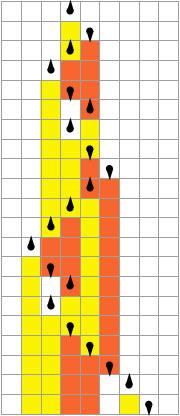
The simple 2,3 Turing Machine (a head with only two states and a tape that can use 3 symbols) is shown to be capable of universal computation. Full article @ Nature News
The state of the head (up or down droplet) and the pattern of colour (orange, yellow and white) in a given row depends upon the row above. A simple start can lead to an incredibly complex picture. (Wolfram Institute)
"Brain-Like Chip May Solve Computers' Big Problem: Energy. The future of computing may depend on embracing the chaos that defines human thinking". Full article @ discover.com.
"A group led by a Princeton University computer security researcher has developed a simple method to steal encrypted information stored on computer hard disks." Full Story @ New York Times
I love how this method higlights the physical constarints on computing memory...
"If handled appropriately, data about Internet-based communication and interactivity could revolutionize our understanding of collective human behaviour". Full essay @A twenty-first century science : Article : Nature