
Wednesday, August 28, 2013
Advances in Artificial Life, ECAL 2013
The proceedings for ECAL 2013 are available to download from MIT Press. Advances in Artificial Life, ECAL 2013 | The MIT Press

Labels: Artificial Life


Saturday, January 12, 2013
Videocasts of the Alan Turing Symposium
On December 11th, 2012, the Calouste Gulbenkian Foundation hosted The Alan Turing Centenary Symposium, organized by the Instituto Gulbenkian de Ciência, to celebrate Alan Turing's centenary and discuss his legacy. Among the invited speakers were Sidney Brenner, Nobel Laureate in Physiology or Medicine 2002, the writer David Leavitt, and the scientists Luís Rocha (Instituto Gulbenkian de Ciência and Indiana University), António Machiavelo (Universidade do Porto) and Christof Teuscher (Portland State University). A video library with all the talks at this conference is available. The videocasts are also shown below in three blocks:
Watch live streaming video from fcglive at livestream.com
Watch live streaming video from fcglive at livestream.com
Watch live streaming video from fcglive at livestream.com
Labels: artificial intelligence, Artificial Life, biocomplexity, computation, informatics, turing
Monday, November 23, 2009
Swarm Chemistry
"Swarm Chemistry" is the pilot research project run by Hiroki Sayama in the Department of Bioengineering at Binghamton University, as well as the interactive simulation software developed and used for the project.
We study the collective dynamics of heterogeneous self-propelled particle swarms and develop novel methods of decentralized control and interactive design of self-organizing decentralized systems. Swarm agents steer their motion according to a set of simple kinetic rules, similar to those in Craig Reynolds' "Boids". Each agent in our model has its own kinetic parameters that may be different from others, so that we can mix several different types of swarm agents into a single population and see how they kinetically react and form a dynamic pattern.
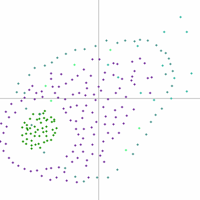
We study the collective dynamics of heterogeneous self-propelled particle swarms and develop novel methods of decentralized control and interactive design of self-organizing decentralized systems. Swarm agents steer their motion according to a set of simple kinetic rules, similar to those in Craig Reynolds' "Boids". Each agent in our model has its own kinetic parameters that may be different from others, so that we can mix several different types of swarm agents into a single population and see how they kinetically react and form a dynamic pattern.
Labels: Artificial Life, simulation, Swarms
Monday, April 06, 2009
3-D vision of life’s dawn
"A new technique allowing virtual dissections of half-billion-year-old fossil embryos is producing the first three-dimensional images of the dawn of life. It reveals a universe of detail impossible using previous methods, and researchers said it was pushing back the frontiers of science much as the scanning electron microscope did half a century ago." Full Story @ MSNBC: Breakthrough gives 3-D vision of life’s dawn - Science - MSNBC.com

Labels: Artificial Life, origin, visualization
Sunday, February 15, 2009
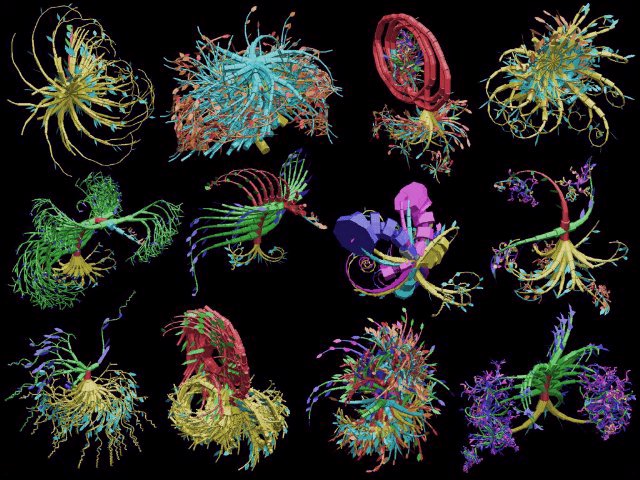
10th European Conference on Artificial Life
ECAL2009: 10th European Conference on Artificial Life. September 13-16 2009. Budapest, Hungary
Labels: Artificial Life, conference
Monday, January 26, 2009
Artificial Life on Nova
The PBS show Nova explored recent advances in Artificial and Synthetic Life. See the segment.

Labels: Artificial Life, synthetic life

