
Thursday, February 13, 2014
Termite robot builders
Justin Werfel and his group "have developed small robots that behave much like termites. The insects build impressive, metres-high structures even though they can follow only simple rules and have no knowledge of an overall plan."
Full news article @ BBC news

Labels: collective intelligence, robots, Swarms


Tuesday, November 15, 2011
Structure and dynamics of interactions in schooling fish
"The interactions revealed here may help account for the rapid changes in speed and direction that enable real animal groups to stay cohesive and amplify important social information". Full paper @ PNAS
Katz et al [2011]. PNAS November 15, 2011 vol. 108 no. 46 18720-18725
See also:
"Collective motion, where large numbers of individuals move synchronously together, is achieved when individuals adopt interaction rules that determine how they respond to their neighbors’ movements and positions. These rules determine how group-living animals move, make decisions, and transmit information between individuals. Nonetheless, few studies have explicitly determined these interaction rules in moving groups, and very little is known about the interaction rules of fish. Here, we identify three key rules for the social interactions of mosquitofish (Gambusia holbrooki)". Herbert-Read et al [2011].PNAS November 15, 2011 vol. 108 no. 46 18726-18731
.jpg_550.jpg)
Katz et al [2011]. PNAS November 15, 2011 vol. 108 no. 46 18720-18725
See also:
"Collective motion, where large numbers of individuals move synchronously together, is achieved when individuals adopt interaction rules that determine how they respond to their neighbors’ movements and positions. These rules determine how group-living animals move, make decisions, and transmit information between individuals. Nonetheless, few studies have explicitly determined these interaction rules in moving groups, and very little is known about the interaction rules of fish. Here, we identify three key rules for the social interactions of mosquitofish (Gambusia holbrooki)". Herbert-Read et al [2011].PNAS November 15, 2011 vol. 108 no. 46 18726-18731
Labels: collective behavior, fish, Swarms
Monday, November 23, 2009
Swarm Chemistry
"Swarm Chemistry" is the pilot research project run by Hiroki Sayama in the Department of Bioengineering at Binghamton University, as well as the interactive simulation software developed and used for the project.
We study the collective dynamics of heterogeneous self-propelled particle swarms and develop novel methods of decentralized control and interactive design of self-organizing decentralized systems. Swarm agents steer their motion according to a set of simple kinetic rules, similar to those in Craig Reynolds' "Boids". Each agent in our model has its own kinetic parameters that may be different from others, so that we can mix several different types of swarm agents into a single population and see how they kinetically react and form a dynamic pattern.
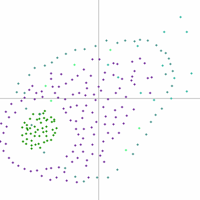
We study the collective dynamics of heterogeneous self-propelled particle swarms and develop novel methods of decentralized control and interactive design of self-organizing decentralized systems. Swarm agents steer their motion according to a set of simple kinetic rules, similar to those in Craig Reynolds' "Boids". Each agent in our model has its own kinetic parameters that may be different from others, so that we can mix several different types of swarm agents into a single population and see how they kinetically react and form a dynamic pattern.
Labels: Artificial Life, simulation, Swarms
Wednesday, April 22, 2009
Chemical brain controls nanobots
A tiny chemical "brain" which could one day act as a remote control for swarms of nano-machines has been invented. The molecular device - just two billionths of a metre across - was able to control eight of the microscopic machines simultaneously in a test. Full Story @
BBC NEWS|Science/Nature

BBC NEWS|Science/Nature
Labels: nanobots, robots, Swarms
Monday, April 20, 2009
Who's the Queen?
Biologists are finding that in some social insects nature, not nurture, determines whether offspring become workers or royalty. Full article @ Science

Labels: genetics, social agents, Swarms
Bee social activity tied to gene
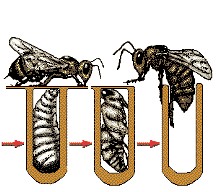
A gene involved in egg production also helps honeybees exhibit some crucial social behaviors that distinguish them from solitary insects, researchers report in PLoS Biology this week. Full Story @ The Scientist
Labels: social agents, Swarms
Thursday, April 16, 2009
From Ants to People, an Instinct to Swarm
"By studying army ants — as well as birds, fish, locusts and other swarming animals — Dr. Couzin and his colleagues are starting to discover simple rules that allow swarms to work so well. Those rules allow thousands of relatively simple animals to form a collective brain able to make decisions and move like a single organism." Full Story @ New York Times

Labels: collective behavior, collective intelligence, Swarms
Saturday, January 17, 2009
Exploring Consciousness through the Study of Bees
"Bees display a remarkable range of talents—abilities that in a mammal such as a dog we would associate with consciousness". Full article @ Scientific American

Labels: intelligence, Swarms

