
Tuesday, September 17, 2013
How Robots Can Trick You Into Loving Them
"In the future, more robots will occupy that strange gray zone: doing not only jobs that humans can do but also jobs that require social grace. In the last decade, an interdisciplinary field of research called Human-Robot Interaction has arisen to study the factors that make robots work well with humans, and how humans view their robotic counterparts." Full article @ NYTimes.com

Labels: human-robot interaction, robots, social agents


Tuesday, February 12, 2013
Evolution of fairness in the one-shot anonymous Ultimatum Game
"Here we show that using stochastic evolutionary game theory, where agents make mistakes when judging the payoffs and strategies of others, natural selection favors fairness." Full article @ PNAS

Labels: Agent-based modeling, cooperation, evolutionary algorithms, social agents
Thursday, September 02, 2010
Robot meet and greet: ASIMO works on its social skills this week
"People need to be able to comfortably communicate with the robot so that it can react properly to their commands and carry out their wishes when assistance is needed." Full news piece @ Scientific American Gallery

Labels: robots, social agents
Monday, April 20, 2009
Who's the Queen?
Biologists are finding that in some social insects nature, not nurture, determines whether offspring become workers or royalty. Full article @ Science

Labels: genetics, social agents, Swarms
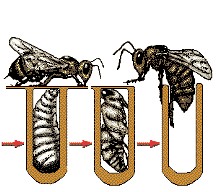
Bee social activity tied to gene
A gene involved in egg production also helps honeybees exhibit some crucial social behaviors that distinguish them from solitary insects, researchers report in PLoS Biology this week. Full Story @ The Scientist
Labels: social agents, Swarms
Robot Cockroach Tests Insect Decision-Making Behavior
"Robot cockroaches coated with pheromones are so well accepted by the household pests that the robots become part of the insects' collective decision-making process". Full article @ Science

Labels: biomimetics, robots, social agents
Friday, March 27, 2009
Strategies in Prisoner's Dilemma
"Proving that a new approach can secure victory in a classic strategy game, a team from England's Southampton University has won the 20th-anniversary Iterated Prisoner's Dilemma competition, toppling the long-term winner from its throne. The Southampton group, whose primary research area is software agents, said its strategy involved a series of moves allowing players to recognize each other and act cooperatively". Full Story @ Wired News.

Labels: Agent-based modeling, Prisoner's Dilemma, social agents

