
Thursday, August 08, 2013
The Minimal Complexity of Adapting Agents Increases with Fitness
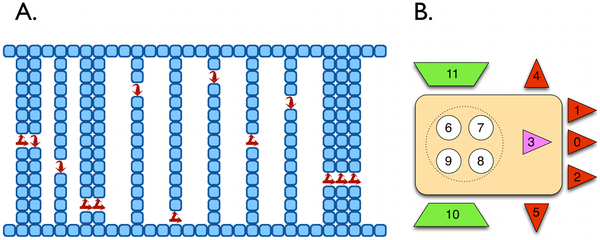
"What is the relationship between the complexity and the fitness of evolved organisms, whether natural or artificial? It has been asserted, primarily based on empirical data, that the complexity of plants and animals increases as their fitness within a particular environment increases via evolution by natural selection. We simulate the evolution of the brains of simple organisms living in a planar maze that they have to traverse as rapidly as possible. Their connectome evolves over 10,000s of generations. We evaluate their circuit complexity, using four information-theoretical measures, including one that emphasizes the extent to which any network is an irreducible entity. We find that their minimal complexity increases with their fitness." Full article @ PLOS Computational Biology
Labels: adaptation, complexity, connectome, information


Information and Efficiency in the Nervous System
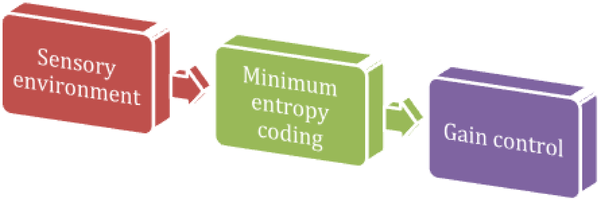
"we consider the imperatives for neurons to optimise computational and metabolic efficiency, wherein benefits and costs trade-off against each other in the context of self-organised and adaptive behaviour. In particular, we try to link information theoretic (variational) and thermodynamic (Helmholtz) free-energy formulations of neuronal processing and show how they are related in a fundamental way through a complexity minimisation lemma." Full article @ PLOS Computational Biology
Labels: adaptive behavior, information, self-organization
Tuesday, June 18, 2013
Information Driven Self-Organization of Complex Robotic Behaviors
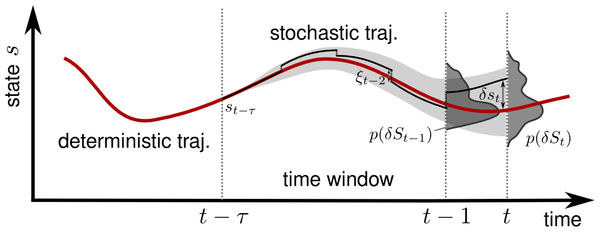
"Information theory is a powerful tool to express principles to drive autonomous systems because it is domain invariant and allows for an intuitive interpretation. This paper studies the use of the predictive information (PI), also called excess entropy or effective measure complexity, of the sensorimotor process as a driving force to generate behavior. We study nonlinear and nonstationary systems and introduce the time-local predicting information (TiPI) which allows us to derive exact results together with explicit update rules for the parameters of the controller in the dynamical systems framework. In this way the information principle, formulated at the level of behavior, is translated to the dynamics of the synapses. We underpin our results with a number of case studies with high-dimensional robotic systems. We show the spontaneous cooperativity in a complex physical system with decentralized control. Moreover, a jointly controlled humanoid robot develops a high behavioral variety depending on its physics and the environment it is dynamically embedded into. The behavior can be decomposed into a succession of low-dimensional modes that increasingly explore the behavior space. This is a promising way to avoid the curse of dimensionality which hinders learning systems to scale well." Full article @ PLOS ONE: Information Driven Self-Organization of Complex Robotic Behaviors
Labels: information, robots
Sunday, May 05, 2013
1953: When Genes Became “Information”
"In 1953, Watson and Crick not only described the double-helix structure of DNA, but also embraced the idea that genes contained a code that expresses information and thereby changed our view of life. This article traces how these ideas entered biological thinking and highlights the connections between different branches of science at the time, exploring the power of metaphor in science." Full article @ Cell

Labels: cybernetics, dna, information, life
Friday, March 08, 2013
The Future of Quantum Information Processing
"In a world overwhelmed by increasing amounts of data, finding new ways to store and process information has become a necessity. Conventional silicon-based electronics has experienced rapid and steady growth, thanks to the progressive miniaturization of its basic component, the transistor, but that trend cannot continue indefinitely." Special issue @ Science

Labels: computation, information, quantum computing
Monday, October 01, 2012
Complexity and information: Measuring emergence, self-organization, and homeostasis at multiple scales - Gershenson - 2012 - Complexity - Wiley Online Library
"we use information theory to provide abstract and concise measures of complexity, emergence, self-organization, and homeostasis. The purpose is to clarify the meaning of these concepts with the aid of the proposed formal measures. In a simplified version of the measures (focusing on the information produced by a system), emergence becomes the opposite of self-organization, while complexity represents their balance." Full article @ Complexity

Labels: complexity, information, self-organization
Tuesday, September 13, 2011
TURING'S CATHEDRAL by George Dyson
"In the digital universe, there are two kinds of bits: bits that represent structure (differences in space) and bits that represent sequence (differences in time). Digital computers — as formalized by Alan Turing, and delivered by John von Neumann — are devices that translate between these two species of bits according to definite rules." Full piece @ Edge

Labels: computation, information, turing, Von Neumann
Wednesday, September 08, 2010
Single cell 'can store memories'
"Just one brain cell is capable of holding fleeting memories vital for our everyday life" Full article @ BBC NEWS. Very interesting discovery about information-processing and memory in the brain.

Labels: brain, information, memory
Friday, September 03, 2010
Workshop on Guided Self-Organization
The School of Informatics & Computing (SoIC), Complex Networks and Systems Center for Research (CNetS), and Pervasive Technology Institute (PTI) at Indiana University (IU) are pleased to host the 3rd International Workshop on Guided Self-Organization, September 4-6, 2010. Please join us!
The GSO 3 Program

The GSO 3 Program
Labels: dynamical systems, information, self-organization
Tuesday, August 31, 2010
Informational Space dust?
Could alien life exist in the form of dancing specks of dust? According to a new simulation, electrically charged dust can organise itself into DNA-like double helixes that behave in many ways like living organisms, reproducing and passing on information to one another. Full article @ The New Scientist Space

Labels: information, life
Monday, February 16, 2009
a Code Beyond Genetics in DNA
"The genetic code specifies all the proteins that a cell makes. The second code, superimposed on the first, sets the placement of the nucleosomes, miniature protein spools around which the DNA is looped. The spools both protect and control access to the DNA itself". Full Story: Scientists Say They’ve Found a Code Beyond Genetics in DNA - New York Times
Research Article: Segal et al [2006]. A genomic code for nucleosome positioning. Nature 442, 772-778.

Research Article: Segal et al [2006]. A genomic code for nucleosome positioning. Nature 442, 772-778.
Labels: code, genetics, information
Sunday, February 15, 2009
Bacterial genome found within a fly's
"DNA transfer from bacteria to animals is more common than thought. Researchers have found a surprise hidden in the DNA of a fruitfly: what seems to be the entire genome of a parasitic bacterium called Wolbachia. Smaller bits of the promiscuous parasite's genetic material turned up in worms and wasps, too." Full Sttory @ news@nature.com

Wolbachia bacteria (yellow) within the developing egg of a fruit fly (red).
Labels: bacteria, dna, DNA transfer, information

