
Thursday, August 08, 2013
The Minimal Complexity of Adapting Agents Increases with Fitness
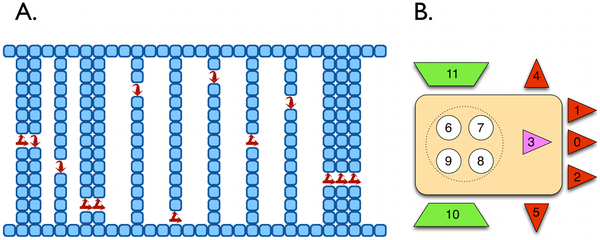
"What is the relationship between the complexity and the fitness of evolved organisms, whether natural or artificial? It has been asserted, primarily based on empirical data, that the complexity of plants and animals increases as their fitness within a particular environment increases via evolution by natural selection. We simulate the evolution of the brains of simple organisms living in a planar maze that they have to traverse as rapidly as possible. Their connectome evolves over 10,000s of generations. We evaluate their circuit complexity, using four information-theoretical measures, including one that emphasizes the extent to which any network is an irreducible entity. We find that their minimal complexity increases with their fitness." Full article @ PLOS Computational Biology
Labels: adaptation, complexity, connectome, information


Monday, February 11, 2013
Connecting a Connectome to Behavior
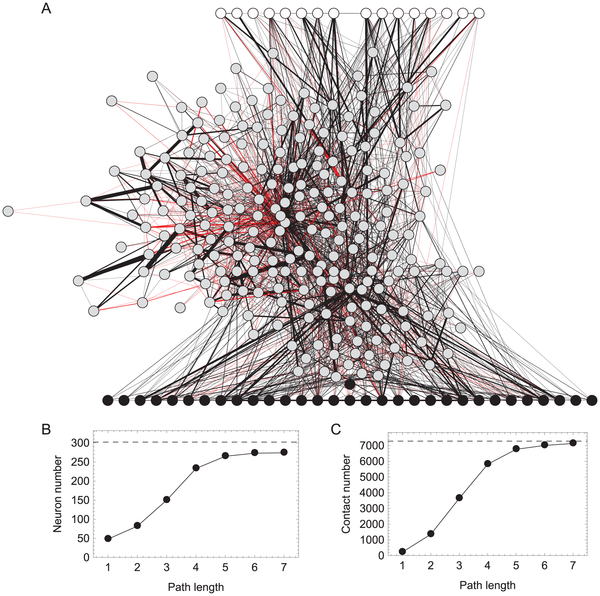
"We develop a neuroanatomically-grounded model of salt klinotaxis, a form of chemotaxis in which changes in orientation are directed towards the source through gradual continual adjustments. We identify a minimal klinotaxis circuit by systematically searching the C. elegans connectome for pathways linking chemosensory neurons to neck motor neurons, and prune the resulting network based on both experimental considerations and several simplifying assumptions. We then use an evolutionary algorithm to find possible values for the unknown electrophsyiological parameters in the network such that the behavioral performance of the entire model is optimized to match that of the animal. Multiple runs of the evolutionary algorithm produce an ensemble of such models. We analyze in some detail the mechanisms by which one of the best evolved circuits operates and characterize the similarities and differences between this mechanism and other solutions in the ensemble." Full article @ PLOS Computational Biology
Labels: animal behavior, connectome, robots

