
Thursday, August 08, 2013
The Minimal Complexity of Adapting Agents Increases with Fitness
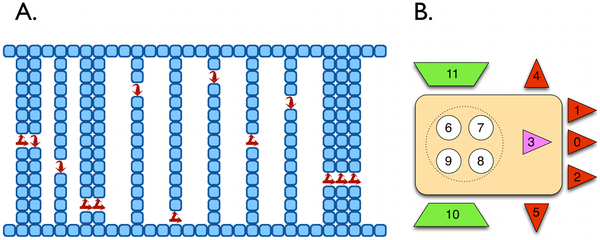
"What is the relationship between the complexity and the fitness of evolved organisms, whether natural or artificial? It has been asserted, primarily based on empirical data, that the complexity of plants and animals increases as their fitness within a particular environment increases via evolution by natural selection. We simulate the evolution of the brains of simple organisms living in a planar maze that they have to traverse as rapidly as possible. Their connectome evolves over 10,000s of generations. We evaluate their circuit complexity, using four information-theoretical measures, including one that emphasizes the extent to which any network is an irreducible entity. We find that their minimal complexity increases with their fitness." Full article @ PLOS Computational Biology
Labels: adaptation, complexity, connectome, information


Tuesday, February 05, 2013
Complexity Explorer
"Santa Fe Institute's Introduction to Complexity course is now enrolling!
This free online course is open to anyone, and has no prerequisites. Watch the Intro Video to learn what this course is about and how to take it"
This free online course is open to anyone, and has no prerequisites. Watch the Intro Video to learn what this course is about and how to take it"
Labels: complex systems, complexity, course
Thursday, October 11, 2012
A Dynamical-Systems View of Stem Cell Biology
"During development, cells undergo a unidirectional course of differentiation that progressively decreases the number of cell types they can potentially become. Stem cells, however, keep their potential to both proliferate and differentiate. A very important issue then is to understand the characteristics that distinguish stem cells from other cell types and allow them to conduct stable proliferation and differentiation. Here, we review relevant dynamical-systems approaches to describe the state transition between stem and differentiated cells, with an emphasis on fluctuating and oscillatory gene expression levels, as these represent the specific properties of stem cells. Relevance between recent experimental results and dynamical-systems descriptions of stem cell differentiation is also discussed." Full perspective @ Science

Labels: attractor behavior, complexity, development, dynamical systems, epigenetic landscape, modeling
Monday, October 01, 2012
Complexity and information: Measuring emergence, self-organization, and homeostasis at multiple scales - Gershenson - 2012 - Complexity - Wiley Online Library
"we use information theory to provide abstract and concise measures of complexity, emergence, self-organization, and homeostasis. The purpose is to clarify the meaning of these concepts with the aid of the proposed formal measures. In a simplified version of the measures (focusing on the information produced by a system), emergence becomes the opposite of self-organization, while complexity represents their balance." Full article @ Complexity

Labels: complexity, information, self-organization
Wednesday, January 20, 2010
Engineering cellular synchrony
"Scientists have engineered bacteria that can communicate with each other in a synchronized manner, lighting up in waves of fluorescent green [...] The engineered cells also offer a new model system for studying emergent systems, or how complex properties -- such as synchronized oscillation -- arise from simpler starting materials -- a two genes network." Full article @ The Scientist.

A supernova burst in a colony of coupled genetic clocks after critical cell density.
Image: Tal Danino, Octavio Mondragon-Palamino, Lev Tsimring
Labels: bacteria, complexity, dynamical systems
Sunday, March 22, 2009
complexity science map
These maps are always interesting even if no two-dimensional map can do justice to such an interdisciplinary field---at leas it makes a coolScience t-shirt...

Labels: complex systems, complexity
Wednesday, February 18, 2009
The long and short of RNAs
"The known world of RNA is expanding faster than that of any other cellular building block. The latest additions are types of long and short non-coding RNAs formed by bidirectional transcription and unusual processing. The relationship between DNA, RNA and protein is no longer as simple as we once thought — that specific genomic sequences are transcribed into messenger RNAs, which are then translated into proteins. In recent years, a flurry of studies has reported the existence of a large and growing family of non-protein-coding RNAs (ncRNAs), describing the different mechanisms of their transcription and their role in regulating gene expression." Full article @ Nature

Labels: complexity, gene regulation, RNA
Monday, January 12, 2009
Biology's Gift to a Complex World
"How studying biological interactions and evolution yields techniques for predicting the outcome of complex interactions". By John Holland @ The Scientist

Labels: biology, complexity, genetic algorithms

