SSIE-483X/583X: evolutionary systems and biologically inspired computing
Thursday, April 25, 2013
Stephen Hawking’s advice for twenty-first century grads: Embrace complexity | The Curious Wavefunction, Scientific American Blog Network
"As the economy continues to chart its own tortuous, uncertain course, there seems to have been a fair amount of much-needed discussion on the kinds of skills new grads should possess." Blog post @ The Curious Wavefunction, Scientific American Blog Network,
"A quantitative description of a complex system is inherently limited by our ability to estimate the system’s internal state from experimentally accessible outputs. Although the simultaneous measurement of all internal variables, like all metabolite concentrations in a cell, offers a complete description of a system’s state, in practice experimental access is limited to only a subset of variables, or sensors. A system is called observable if we can reconstruct the system’s complete internal state from its outputs. Here, we adopt a graphical approach derived from the dynamical laws that govern a system to determine the sensors that are necessary to reconstruct the full internal state of a complex system. We apply this approach to biochemical reaction systems, finding that the identified sensors are not only necessary but also sufficient for observability. The developed approach can also identify the optimal sensors for target or partial observability, helping us reconstruct selected state variables from appropriately chosen outputs, a prerequisite for optimal biomarker design. Given the fundamental role observability plays in complex systems, these results offer avenues to systematically explore the dynamics of a wide range of natural, technological and socioeconomic systems." Full article @ PNAS
"Santa Fe Institute's Introduction to Complexity course is now enrolling!
This free online course is open to anyone, and has no prerequisites. Watch the Intro Video to learn what this course is about and how to take it"
"We present schema redescription as a methodology to characterize canalization in automata networks used to model biochemical regulation and signalling. In our formulation, canalization becomes synonymous with redundancy present in the logic of automata. This results in straightforward measures to quantify canalization in an automaton (micro-level), which is in turn integrated into a highly scalable framework to characterize the collective dynamics of large-scale automata networks (macro-level). This way, our approach provides a method to link micro- to macro-level dynamics -- a crux of complexity. Several new results ensue from this methodology: uncovering of dynamical modularity (modules in the dynamics rather than in the structure of networks), identification of minimal conditions and critical nodes to control the convergence to attractors, simulation of dynamical behaviour from incomplete information about initial conditions, and measures of macro-level canalization and robustness to perturbations. We exemplify our methodology with a well-known model of the intra- and inter cellular genetic regulation of body segmentation in Drosophila melanogaster. We use this model to show that our analysis does not contradict any previous findings. But we also obtain new knowledge about its behaviour: a better understanding of the size of its wild-type attractor basin (larger than previously thought), the identification of novel minimal conditions and critical nodes that control wild-type behaviour, and the resilience of these to stochastic interventions. Our methodology is applicable to any complex network that can be modelled using automata, but we focus on biochemical regulation and signalling, towards a better understanding of the (decentralized) control that orchestrates cellular activity -- with the ultimate goal of explaining how do cells and tissues 'compute'." Full pre-print:
"The human brain is exceedingly complex and studying it encompasses gathering information across a range of levels, from molecular processes to behavior. The sheer breadth of this undertaking has perhaps led to an increased specialization of brain research and a concomitant fragmentation of our knowledge. A potential solution is to integrate all of this knowledge into a coherent simulation of the brain". Full article @ Science
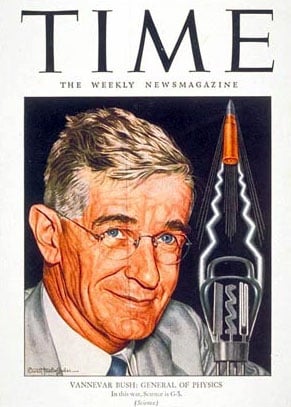
"Before he became America's first de facto science adviser and before he helped lay the foundation for the National Science Foundation, Vannevar Bush was a professor of Electrical Engineering and, eventually, dean of Engineering and vice president at the Massachusetts Institute of Technology (MIT). In those capacities, he came in contact with some of the nation's best and brightest minds in their formative years. But after two decades in such a rarified academic environment, Bush had become disenchanted by the increasing specialization of undergraduate curricula in science and engineering in America (1). He felt that education in these fields placed too much emphasis on information transferral from teacher to student and too little on deep understanding and intellectual synthesis by the student. Bush was among the first to anticipate that massive amounts of information would someday be universally and readily available to all, such that our ability to communicate knowledge through classes would become far less important than our ability to inspire students to do something creative, and valuable, with it." Full article @ Science
"Identifying causal networks is important for effective policy and management recommendations on climate, epidemiology, financial regulation, and much else. We introduce a method, based on nonlinear state space reconstruction, that can distinguish causality from correlation. It extends to nonseparable weakly connected dynamic systems (cases not covered by the current Granger causality paradigm)." Full article @ Science
"Bumblebees are remarkable navigators. While their flight paths may look scattered to the casual eye, all that buzzing about is anything but random. Like the travelling salesman in the famous mathematical problem of how to take the shortest path along multiple stops, bumblebees quickly find efficient routes among flowers. And once they find a good route, they stick to it. The same goes for other animals from hummingbirds to bats to primates that depend on patchy resources such as nectar and fruit. Perhaps this is not such a surprising feat for animals with relatively high brain power. But how do bumblebees, with their tiny brains, manage it? " Full synopsis @ PLOS Biology
"Identifying causal networks is important for effective policy and management recommendations on climate, epidemiology, financial regulation, and much else. Here, we introduce a method, based on nonlinear state space reconstruction, that can distinguish causality from correlation. It extends to nonseparable weakly connected dynamic systems (cases not covered by the current Granger causality paradigm)." Full article @ Science
"The Turing, or reaction-diffusion (RD), model is one of the best-known theoretical models used to explain self-regulated pattern formation in the developing animal embryo. Although its real-world relevance was long debated, a number of compelling examples have gradually alleviated much of the skepticism surrounding the model. The RD model can generate a wide variety of spatial patterns, and mathematical studies have revealed the kinds of interactions required for each, giving this model the potential for application as an experimental working hypothesis in a wide variety of morphological phenomena. In this review, we describe the essence of this theory for experimental biologists unfamiliar with the model, using examples from experimental studies in which the RD model is effectively incorporated.". Full review @ Science
"Theory suggests that the risk of critical transitions in complex systems can be revealed by generic indicators. A lab study of extinction in plankton populations provides experimental support for that principle." Full news article @ Nature. Se also the research article:
These maps are always interesting even if no two-dimensional map can do justice to such an interdisciplinary field---at leas it makes a coolScience t-shirt...
"Some peculiar microorganisms are showing systems biology can color in what's missing from models of biochemical and cellular networks." Full article @ The Scientist