
Monday, October 21, 2013
Human Self-Organization?
Burning Man 2013 Time-Lapse: Seen Miles Away From A Mountain Top
Labels: human behavior, music, self-organization


Thursday, August 08, 2013
Information and Efficiency in the Nervous System
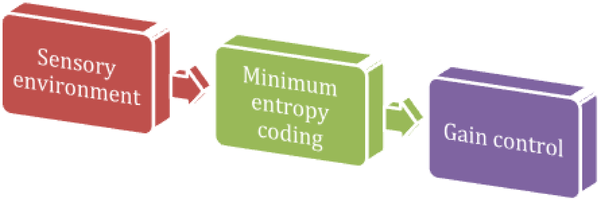
"we consider the imperatives for neurons to optimise computational and metabolic efficiency, wherein benefits and costs trade-off against each other in the context of self-organised and adaptive behaviour. In particular, we try to link information theoretic (variational) and thermodynamic (Helmholtz) free-energy formulations of neuronal processing and show how they are related in a fundamental way through a complexity minimisation lemma." Full article @ PLOS Computational Biology
Labels: adaptive behavior, information, self-organization
Tuesday, January 29, 2013
Canalization and control in automata networks
"We present schema redescription as a methodology to characterize canalization in automata networks used to model biochemical regulation and signalling. In our formulation, canalization becomes synonymous with redundancy present in the logic of automata. This results in straightforward measures to quantify canalization in an automaton (micro-level), which is in turn integrated into a highly scalable framework to characterize the collective dynamics of large-scale automata networks (macro-level). This way, our approach provides a method to link micro- to macro-level dynamics -- a crux of complexity. Several new results ensue from this methodology: uncovering of dynamical modularity (modules in the dynamics rather than in the structure of networks), identification of minimal conditions and critical nodes to control the convergence to attractors, simulation of dynamical behaviour from incomplete information about initial conditions, and measures of macro-level canalization and robustness to perturbations. We exemplify our methodology with a well-known model of the intra- and inter cellular genetic regulation of body segmentation in Drosophila melanogaster. We use this model to show that our analysis does not contradict any previous findings. But we also obtain new knowledge about its behaviour: a better understanding of the size of its wild-type attractor basin (larger than previously thought), the identification of novel minimal conditions and critical nodes that control wild-type behaviour, and the resilience of these to stochastic interventions. Our methodology is applicable to any complex network that can be modelled using automata, but we focus on biochemical regulation and signalling, towards a better understanding of the (decentralized) control that orchestrates cellular activity -- with the ultimate goal of explaining how do cells and tissues 'compute'." Full pre-print:
M. Marques-Pita and L.M. Rocha [2013]. "Canalization and control in automata networks: body segmentation in Drosophila Melanogaster". PLOS ONE, In Press.

M. Marques-Pita and L.M. Rocha [2013]. "Canalization and control in automata networks: body segmentation in Drosophila Melanogaster". PLOS ONE, In Press.
Labels: automata, biocomplexity, boolean networks, canalization, complex systems, modularity, self-organization
Self-organization of tissue architecture
"Our knowledge of the principles by which organ architecture develops through complex collective cell behaviours is still limited. Recent work has shown that the shape of such complex tissues as the optic cup forms by self-organization in vitro from a homogeneous population of stem cells. Multicellular self-organization involves three basic processes that are crucial for the emergence of latent intrinsic order. Based on lessons from recent studies, cytosystems dynamics is proposed as a strategy for understanding collective multicellular behaviours, incorporating four-dimensional measurement, theoretical modelling and experimental reconstitution." Full paper @ Nature

Labels: develo, self-organization, stem cells
Monday, October 01, 2012
Complexity and information: Measuring emergence, self-organization, and homeostasis at multiple scales - Gershenson - 2012 - Complexity - Wiley Online Library
"we use information theory to provide abstract and concise measures of complexity, emergence, self-organization, and homeostasis. The purpose is to clarify the meaning of these concepts with the aid of the proposed formal measures. In a simplified version of the measures (focusing on the information produced by a system), emergence becomes the opposite of self-organization, while complexity represents their balance." Full article @ Complexity

Labels: complexity, information, self-organization
Wednesday, August 15, 2012
Living Cities
Carlos Gershenson: Bringing urban technology to life with realtime feedback
Labels: cities, self-organization
Friday, September 03, 2010
Workshop on Guided Self-Organization
The School of Informatics & Computing (SoIC), Complex Networks and Systems Center for Research (CNetS), and Pervasive Technology Institute (PTI) at Indiana University (IU) are pleased to host the 3rd International Workshop on Guided Self-Organization, September 4-6, 2010. Please join us!
The GSO 3 Program

The GSO 3 Program
Labels: dynamical systems, information, self-organization
Tuesday, May 26, 2009
Molecular mechanisms responsible for the generation of Turing patterns
"The reaction–diffusion system is one of the most studied nonlinear mechanisms that generate spatially periodic structures autonomous. On the basis of many mathematical studies using computer simulations, it is assumed that animal skin patterns are the most typical examples of the Turing pattern (stationary periodic pattern produced by the reaction–diffusion system). However, the mechanism underlying pattern formation remains unknown because the molecular or cellular basis of the phenomenon has yet to be identified. In this study, we identified the interaction network between the pigment cells of zebrafish, and showed that this interaction network possesses the properties necessary to form the Turing pattern. When the pigment cells in a restricted region were killed with laser treatment, new pigment cells developed to regenerate the striped pattern. We also found that the development and survival of the cells were influenced by the positioning of the surrounding cells. When melanophores and xanthophores were located at adjacent positions, these cells excluded one another. However, melanophores required a mass of xanthophores distributed in a more distant region for both differentiation and survival. Interestingly, the local effect of these cells is opposite to that of their effects long range. This relationship satisfies the necessary conditions required for stable pattern formation in the reaction–diffusion model. Simulation calculations for the deduced network generated wild-type pigment patterns as well as other mutant patterns. Our findings here allow further investigation of Turing pattern formation within the context of cell biology.". Interactions between zebrafish pigment cells responsible for the generation of Turing patterns — PNAS

Labels: modeling, self-organization, turing
Sunday, April 12, 2009
A Robotic Future
Special Issue on Robotics @ Science/AAAS | Table of Contents: 16 November 2007; 318 (5853)
See:
Making Machines That Make Others of Their Kind. (Though this piece continues the tradition of looking at self-replication as the main concept behind Von neumann's scheme, when its greatest insight is open-ended evolution).
Self-Organization, Embodiment, and Biologically Inspired Robotics: "Robotics researchers increasingly agree that ideas from biology and self-organization can strongly benefit the design of autonomous robots. Biological organisms have evolved to perform and survive in a world characterized by rapid changes, high uncertainty, indefinite richness, and limited availability of information. Industrial robots, in contrast, operate in highly controlled environments with no or very little uncertainty. Although many challenges remain, concepts from biologically inspired (bio-inspired) robotics will eventually enable researchers to engineer machines for the real world that possess at least some of the desirable properties of biological organisms, such as adaptivity, robustness, versatility, and agility".

See:
Making Machines That Make Others of Their Kind. (Though this piece continues the tradition of looking at self-replication as the main concept behind Von neumann's scheme, when its greatest insight is open-ended evolution).
Self-Organization, Embodiment, and Biologically Inspired Robotics: "Robotics researchers increasingly agree that ideas from biology and self-organization can strongly benefit the design of autonomous robots. Biological organisms have evolved to perform and survive in a world characterized by rapid changes, high uncertainty, indefinite richness, and limited availability of information. Industrial robots, in contrast, operate in highly controlled environments with no or very little uncertainty. Although many challenges remain, concepts from biologically inspired (bio-inspired) robotics will eventually enable researchers to engineer machines for the real world that possess at least some of the desirable properties of biological organisms, such as adaptivity, robustness, versatility, and agility".
Labels: embodiment, Emergence, open-ended evolution, robots, self-organization, self-reproduction, synthetic biology

