
Monday, September 09, 2013
Synthetic biological networks
"[We] discuss how the rise of a more recent field known as synthetic biology may allow us to more directly test hypotheses regarding the possible design principles of natural biological networks and systems. In particular, this review focuses on synthetic gene regulatory networks engineered to perform specific functions or exhibit particular dynamic behaviors. Advances in synthetic biology may set the stage to uncover the relationship of potential biological principles to those developed in physics." Full article @ Reports on Progress in PhysicsEmail alert RSS feed

Labels: design principles, gene circuits, synthetic biology


Sunday, May 05, 2013
Recombinatorial Logic
"Logic gates evoke images of circuit boards, but cells are arguably equally good in relying on logic computations. [..] In recent years, there have been multiple reports on rationally designed, genetically encoded logic gates and circuits in living cells. [...] Two studies, [...] by Bonnet et al. and [...] Siuti et al., describe approaches that produce any of the 16 gates, including the notorious XNOR and XOR, in a compact manner by making relatively minor tweaks to the gates' genetic building blocks." Full discussion @ Science

Labels: DNA computing, logic, natural computing, synthetic biology
Wednesday, November 07, 2012
Genetic programs constructed from layered logic gates in single cells
"Genetic programs function to integrate environmental sensors, implement signal processing algorithms and control expression dynamics1. These programs consist of integrated genetic circuits that individually implement operations ranging from digital logic to dynamic circuits2, 3, 4, 5, 6, and they have been used in various cellular engineering applications, including the implementation of process control in metabolic networks and the coordination of spatial differentiation in artificial tissues. [...] Here we apply part mining and directed evolution to build a set of transcriptional AND gates in Escherichia coli. Each AND gate integrates two promoter inputs and controls one promoter output." Full article @ Nature

Labels: gene circuits, synthetic biology
Friday, September 21, 2012
Evolving genomic transcriptional networks
"Combining transcriptomic and signaling data, we develop an evolutionary computational procedure that allows obtaining alternative genomic transcriptional regulatory network (GTRN) that still maintains its adaptability to dynamic environments. We apply our methodology to an E. coli GTRN and show that it could be rewired to simpler transcriptional regulatory structures." Full paper @
PNAA

PNAA
Labels: evolutionary algorithms, gene regulation, synthetic biology, systems biology
Sunday, August 26, 2012
The brainmaker
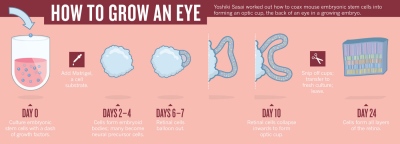
Very Blade Runner! "Yoshiki Sasai has grown an eye and parts of a brain in a dish [from stem cells]." Full news feature @ Nature News
Labels: stem cells, synthetic biology, tissue growth
Friday, September 02, 2011
Logic Circuit for Identification of Cancer Cells
"Engineered biological systems that integrate multi-input sensing, sophisticated information processing, and precisely regulated actuation in living cells could be useful in a variety of applications." Full article @ Multi-Input RNAi-Based Logic Circuit for Identification of Specific Cancer Cells. Science 2 September 2011: Vol. 333 no. 6047 pp. 1307-1311

Labels: synthetic biology, systems biology
Tuesday, January 26, 2010
Synthetic systems biology
"Synthetic biology goes beyond classic genetic engineering as it attempts to engineer living systems to perform new functions not found in nature. Ten years ago this week, Nature published a pair of seminal papers that stimulated 'systems biology' thinking in the field. This web focus gathers these two papers together with papers more recently published by Nature in the same spirit."
Labels: synthetic biology, systems biology
Tuesday, April 21, 2009
Device 'spins silk like spiders'
A device that partially mimics the process by which spiders produce fine, yet super-strong, silks has been built. The team manufactured two genetically-engineered spider silk proteins using bacteria. These were fed into a device that consists of three channels etched into glass. More @ BBC NEWS | Science/Nature

A micrograph shows the artificial silk in more detail
Labels: bio-materials, synthetic biology
Sunday, April 12, 2009
A Robotic Future
Special Issue on Robotics @ Science/AAAS | Table of Contents: 16 November 2007; 318 (5853)
See:
Making Machines That Make Others of Their Kind. (Though this piece continues the tradition of looking at self-replication as the main concept behind Von neumann's scheme, when its greatest insight is open-ended evolution).
Self-Organization, Embodiment, and Biologically Inspired Robotics: "Robotics researchers increasingly agree that ideas from biology and self-organization can strongly benefit the design of autonomous robots. Biological organisms have evolved to perform and survive in a world characterized by rapid changes, high uncertainty, indefinite richness, and limited availability of information. Industrial robots, in contrast, operate in highly controlled environments with no or very little uncertainty. Although many challenges remain, concepts from biologically inspired (bio-inspired) robotics will eventually enable researchers to engineer machines for the real world that possess at least some of the desirable properties of biological organisms, such as adaptivity, robustness, versatility, and agility".

See:
Making Machines That Make Others of Their Kind. (Though this piece continues the tradition of looking at self-replication as the main concept behind Von neumann's scheme, when its greatest insight is open-ended evolution).
Self-Organization, Embodiment, and Biologically Inspired Robotics: "Robotics researchers increasingly agree that ideas from biology and self-organization can strongly benefit the design of autonomous robots. Biological organisms have evolved to perform and survive in a world characterized by rapid changes, high uncertainty, indefinite richness, and limited availability of information. Industrial robots, in contrast, operate in highly controlled environments with no or very little uncertainty. Although many challenges remain, concepts from biologically inspired (bio-inspired) robotics will eventually enable researchers to engineer machines for the real world that possess at least some of the desirable properties of biological organisms, such as adaptivity, robustness, versatility, and agility".
Labels: embodiment, Emergence, open-ended evolution, robots, self-organization, self-reproduction, synthetic biology
Monday, April 06, 2009
Re-engineering Humans
We challenged experts across fields to imagine a new way to solve the problems of human aging. Full story @ The Scientist

Labels: biology, synthetic biology
Thursday, January 15, 2009
iGEM
From Seth Frey:
The International Genetically Engineered Machine (iGEM) is coming to Bloomington. It is a contest built on a set of standards that enable students to design novel organisms for engineering purposes with minimal capital and training.
The most fascinating projects I have found are:
-E. Coli that generates peppermint smell when it is growing and banana smell when it stops
-Another organism that emits a red dye if it is in arsenic laced water; providing a cheap arsenic test.
-Photosensitive E.Coli; literal biofilm. In the attached flier, you see a print of the classic "Hello World". There can be no more overt demonstration of the intent to turn biology into engineering/programming.
These are organisms engineered by students with a toolkit of standardized genes. The callout next Thursday is to recruit a team to participate in iGEM2009. Bioengineering experience is not required. The contest was started at MIT and in the past four years has grown from 5 to 84 participating schools from around the world.
WhereWhenWhat-to-eat:
Thursday, January 22
6:00 pm to 7:00 pm
Jordan Hall room 239
Pizza at 5:45 pm
And for your browsing pleasure:
iGEM 2008 is the most recent contest.
The Registry of Standard Biological Parts, in which a 'part' is a gene that has been modified to suit the easy-to-work-with BioBrick standard.
OpenWetWare provides tech support.

The International Genetically Engineered Machine (iGEM) is coming to Bloomington. It is a contest built on a set of standards that enable students to design novel organisms for engineering purposes with minimal capital and training.
The most fascinating projects I have found are:
-E. Coli that generates peppermint smell when it is growing and banana smell when it stops
-Another organism that emits a red dye if it is in arsenic laced water; providing a cheap arsenic test.
-Photosensitive E.Coli; literal biofilm. In the attached flier, you see a print of the classic "Hello World". There can be no more overt demonstration of the intent to turn biology into engineering/programming.
These are organisms engineered by students with a toolkit of standardized genes. The callout next Thursday is to recruit a team to participate in iGEM2009. Bioengineering experience is not required. The contest was started at MIT and in the past four years has grown from 5 to 84 participating schools from around the world.
WhereWhenWhat-to-eat:
Thursday, January 22
6:00 pm to 7:00 pm
Jordan Hall room 239
Pizza at 5:45 pm
And for your browsing pleasure:
iGEM 2008 is the most recent contest.
The Registry of Standard Biological Parts, in which a 'part' is a gene that has been modified to suit the easy-to-work-with BioBrick standard.
OpenWetWare provides tech support.
Labels: synthetic biology
Wednesday, January 14, 2009
Synthetic genomes brought closer to life
An entire bacterial genome has been reconstructed by stitching together chemically synthesized DNA fragments, bringing the prospect of an artificial living organism one step closer. Full story @ Nature Biotechnology
The actual paper by Gibson et al detailing the process of obtaining a synthetic genome.

The actual paper by Gibson et al detailing the process of obtaining a synthetic genome.
Labels: bacteria, synthetic biology

