
Tuesday, April 29, 2025
Evolution takes multiple paths to evolvability when facing environmental change
"we use digital evolution to show that changing environments facilitate the simultaneous evolution of high mutation rates and a distribution of mutational effects skewed toward beneficial phenotypes. The evolved mutational neighborhoods allow rapid adaptation to previously encountered environments, whereas higher mutation rates aid adaptation to completely new environmental conditions. By precisely tracking evolving lineages and the phenotypes of their mutants, we show that evolving populations localize on phenotypic boundaries between distinct regions of genotype space. Our results demonstrate how evolution shapes multiple determinants of evolvability concurrently, fine-tuning a population’s adaptive responses to unpredictable or recurrent environmental shifts".Full paper @ PNAS.

Labels: #evolution, #evolvability


Optimal flock formation induced by agent heterogeneity
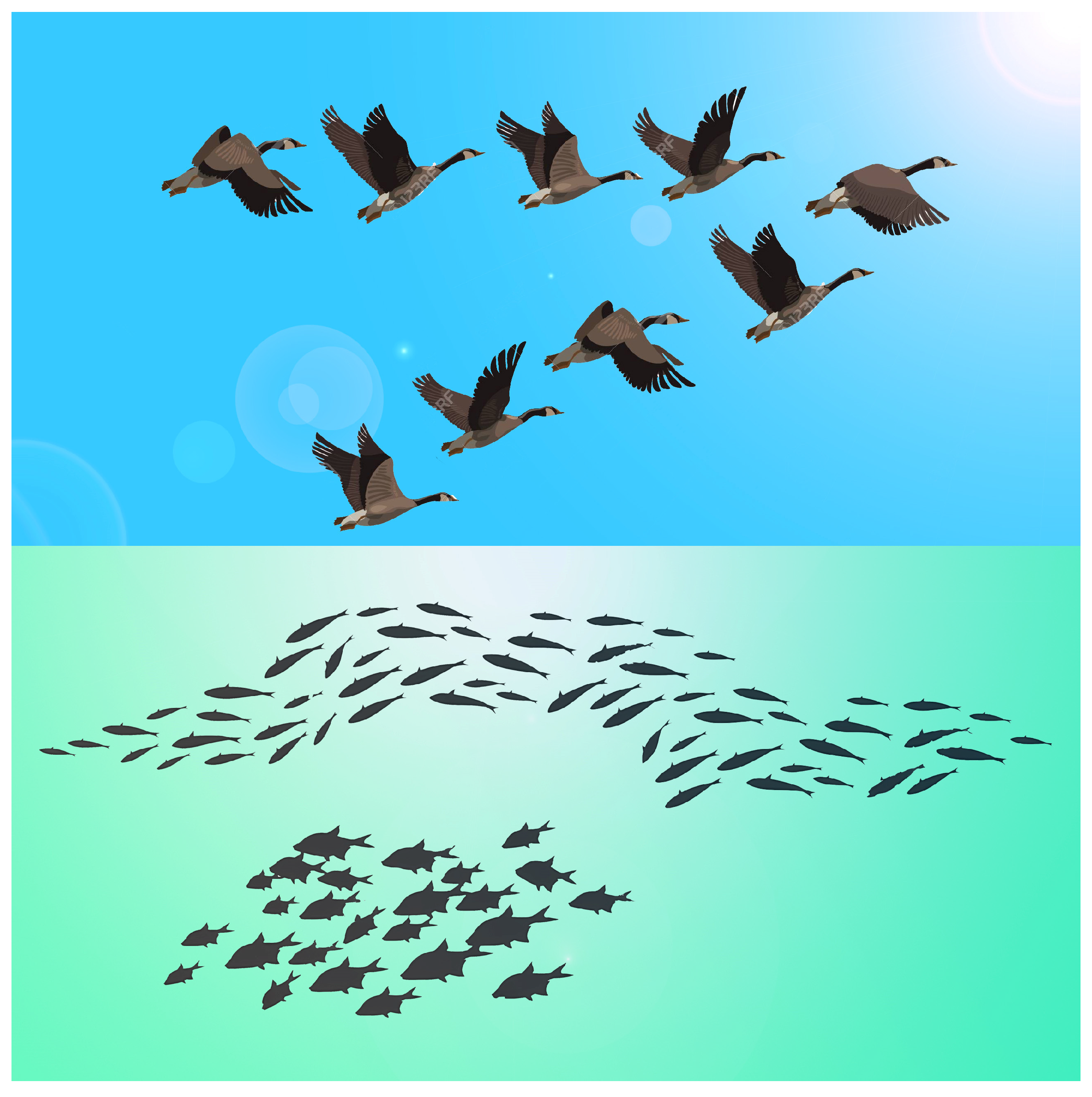
"The study of flocking in biological systems has identified conditions for self-organized collective behavior, inspiring the development of decentralized strategies to coordinate the dynamics of swarms of drones and other autonomous vehicles. Previous research has focused primarily on the role of the time-varying interaction network among agents while assuming that the agents themselves are identical or nearly identical. Here, we depart from this conventional assumption to investigate how inter-individual differences between agents affect the stability and convergence in flocking dynamics." Full article at the ArXiv.
Labels: #collectivebehavior, #flocking

